

Credit unions are bound by the same federal fraud-protection law as the biggest banks — the Electronic Fund Transfer Act (EFTA) and Regulation E. When a credit union tells a member an unauthorized transfer is “your responsibility,” or closes a claim without a real investigation, it may be breaking federal law. Clanton Law Office represents consumers whose credit unions wrongly denied claims for unauthorized electronic transfers.
The rule your credit union hopes you don’t know
Under Regulation E (12 C.F.R. § 1005.2), the definition of “financial institution” expressly includes credit unions. A credit union has no more right to deny a legitimate unauthorized-transfer claim than Bank of America or Wells Fargo does. The National Credit Union Administration (NCUA) enforces these rules for federal credit unions.
Why credit unions have become easy prey for hackers
Here is the pattern we see, and the reason behind it. A large bank like Bank of America has billions of dollars and tens of millions of customers to protect, so it can afford the most sophisticated fraud defenses on the market — dedicated security operations centers, large fraud teams, and real-time monitoring. Against those defenses, only the most sophisticated criminals get through. When those same sophisticated criminals turn to credit unions, they find far softer targets. The skills that beat a top-tier bank’s defenses overwhelm a credit union that never had comparable resources.
The industry’s own data backs this up:
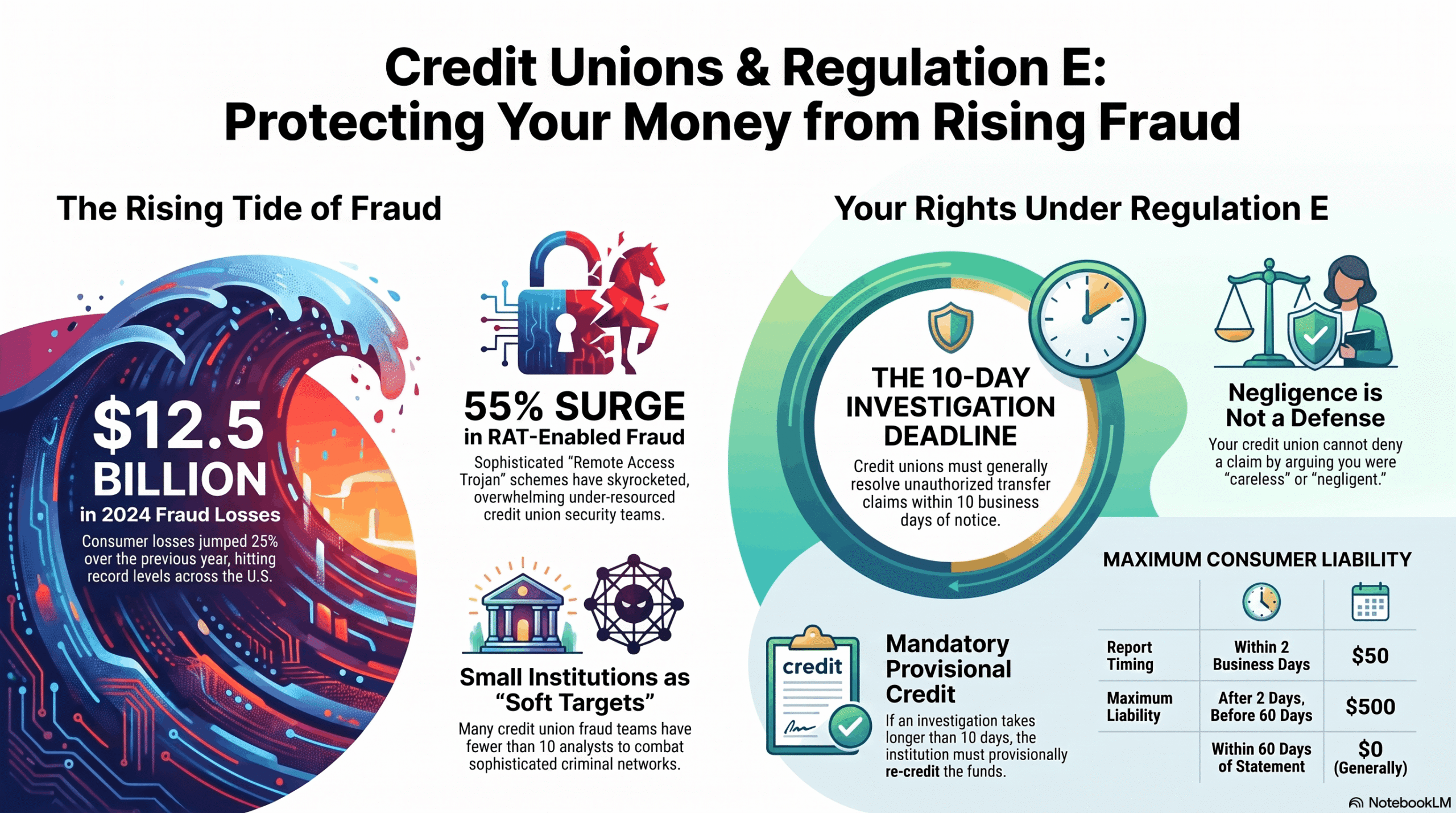
- U.S. consumers reported $12.5 billion in fraud losses in 2024 — a 25% jump over the prior year — and the first half of 2025 alone added roughly $7.1 billion (Federal Trade Commission reporting via America’s Credit Unions).
- Account-takeover fraud caused more than $262 million in losses in 2025, according to FBI figures reported by SecurityWeek.
- Small financial institutions are ideal targets precisely because they lack the security resources bigger banks have — dedicated cybersecurity specialists and operations centers “whose budgets often surpass a [community financial institution’s] budget” (PCBB, 2025).
- Credit-union fraud teams often have fewer than 10 analysts, and 79% of credit-union and community-bank leaders reported fraud losses exceeding $500,000 in 2023 — a higher rate than midsize and large institutions (Thomson Reuters Institute).
- Credit unions saw a 55% increase in remote-access-trojan-enabled fraud in 2025, a category that now accounts for about 15% of all credit-union fraud and was “barely on the radar two years ago.”
None of this is the member’s fault. It is the predictable result of sophisticated attackers meeting under-resourced defenses — and it is exactly why so many credit-union members are now being told “no” after a fraud they never authorized.
The scheme we are seeing right now
Many of the members contacting us describe the same account-takeover playbook:
- A fraudster already has access to the member’s credit-union account.
- The fraudster calls the member, posing as the credit union, warning of “suspicious activity.”
- The fraudster tells the member to type “yes” or read back a code from a text.
- The fraudster presses send on the transfer; the member only responds to the prompt.
- A text from the credit union arrives, the member approves it, and the money is gone.
If that happened to you, you did not “authorize” a payment — you answered a security prompt while a criminal moved your money. Regulation E protects transfers initiated by someone other than you. Here, the person who initiated the transfer was the intruder, not you.
What Regulation E actually requires of your credit union
Investigation deadline. After you report an unauthorized electronic fund transfer, the credit union generally must investigate and resolve the error within 10 business days (12 C.F.R. § 1005.11). If it needs longer, it must provisionally re-credit the disputed amount and may take up to 45 days to finish (up to 90 days for certain new-account, point-of-sale, or foreign transfers).
Your liability is capped. Report a lost or stolen access device within two business days and your maximum liability is $50 (12 C.F.R. § 1005.6). Wait longer and it can rise to $500 — but if the transfer merely appears on your statement and you report it within 60 days, you generally are not liable at all.
Negligence is not a defense the credit union can use. A credit union may not cut your Regulation E protections by claiming you were careless, and its account agreement cannot impose more liability than Regulation E allows.
Unauthorized vs. authorized — the line that decides your case. Regulation E protects transfers made without your authorization (a criminal moved your money). Transfers you were tricked into sending yourself are generally treated as “authorized” and may fall outside Regulation E. If you’re unsure which category you’re in, that’s exactly the question a consumer lawyer can answer — tell us what happened.
What you can recover
When a credit union denies a valid unauthorized-transfer claim without a reasonable investigation, the Electronic Fund Transfer Act allows a consumer to recover actual damages, statutory damages of $100 to $1,000, and court costs plus reasonable attorney’s fees (15 U.S.C. § 1693m). Because the statute shifts fees to the credit union, you generally do not pay attorney’s fees out of pocket to enforce your rights.
Credit unions we handle claims against
We represent members of credit unions of every size:
- Navy Federal Credit Union — the world’s largest credit union (15.2 million members)
- Randolph-Brooks Federal Credit Union (RBFCU) — the largest credit union in Texas
- Security Service Federal Credit Union (SSFCU) — San Antonio–based, one of the largest in the country
Don’t see yours? We handle claims against any credit union — tell us what happened.
Frequently asked questions
Does Regulation E apply to credit unions? Yes. Regulation E (12 C.F.R. § 1005.2) defines “financial institution” to include banks, savings associations, and credit unions. Federal credit unions are supervised for Regulation E compliance by the NCUA, so your credit union has the same error-resolution and reimbursement obligations as a bank.
Are credit unions safer than big banks against fraud? Not necessarily. Large banks can fund far more sophisticated fraud defenses than most credit unions, which often run fraud teams of fewer than 10 analysts. Industry data shows small financial institutions are frequently targeted because they lack the security resources of the largest banks.
My credit union said I was negligent and denied my claim. Is that allowed? Generally, no. Under Regulation E, a financial institution may not consider a consumer’s negligence when deciding liability for an unauthorized electronic fund transfer. A denial based on “you should have been more careful” is often improper.
How long does my credit union have to investigate? Usually 10 business days to resolve the claim, or it must provisionally credit your account and take up to 45 days (up to 90 days for certain transfers). Missing these deadlines can itself be a violation.
Can I sue my credit union for denying a fraud claim? If the transfer was unauthorized and the credit union denied it without a reasonable investigation, you may have a claim under the Electronic Fund Transfer Act for your losses, statutory damages of $100 to $1,000, and attorney’s fees. A consumer-protection attorney can review your denial letter at no cost.
What if I was tricked into sending the money myself? That situation is more complicated. Transfers you personally authorize — even when deceived — are often outside Regulation E. But the facts matter, and many cases mix authorized and unauthorized activity, so it’s worth a lawyer’s review.
Get your credit-union denial reviewed — free
Your credit union is counting on you to accept the denial and move on. You don’t have to. Bring us the denial letter and your transaction record, and a San Antonio consumer-protection attorney will tell you — at no cost and no obligation— whether your transfer was unauthorized under federal law, what your claim may be worth, and the next step. If we take your case, you pay no attorney’s fees out of pocket — the Electronic Fund Transfer Act makes the credit union cover them when you win. Federal deadlines apply, so don’t wait.
👉 Start your free case review »
Was it a specific institution? See our Navy Federal, RBFCU, or Security Service pages.