

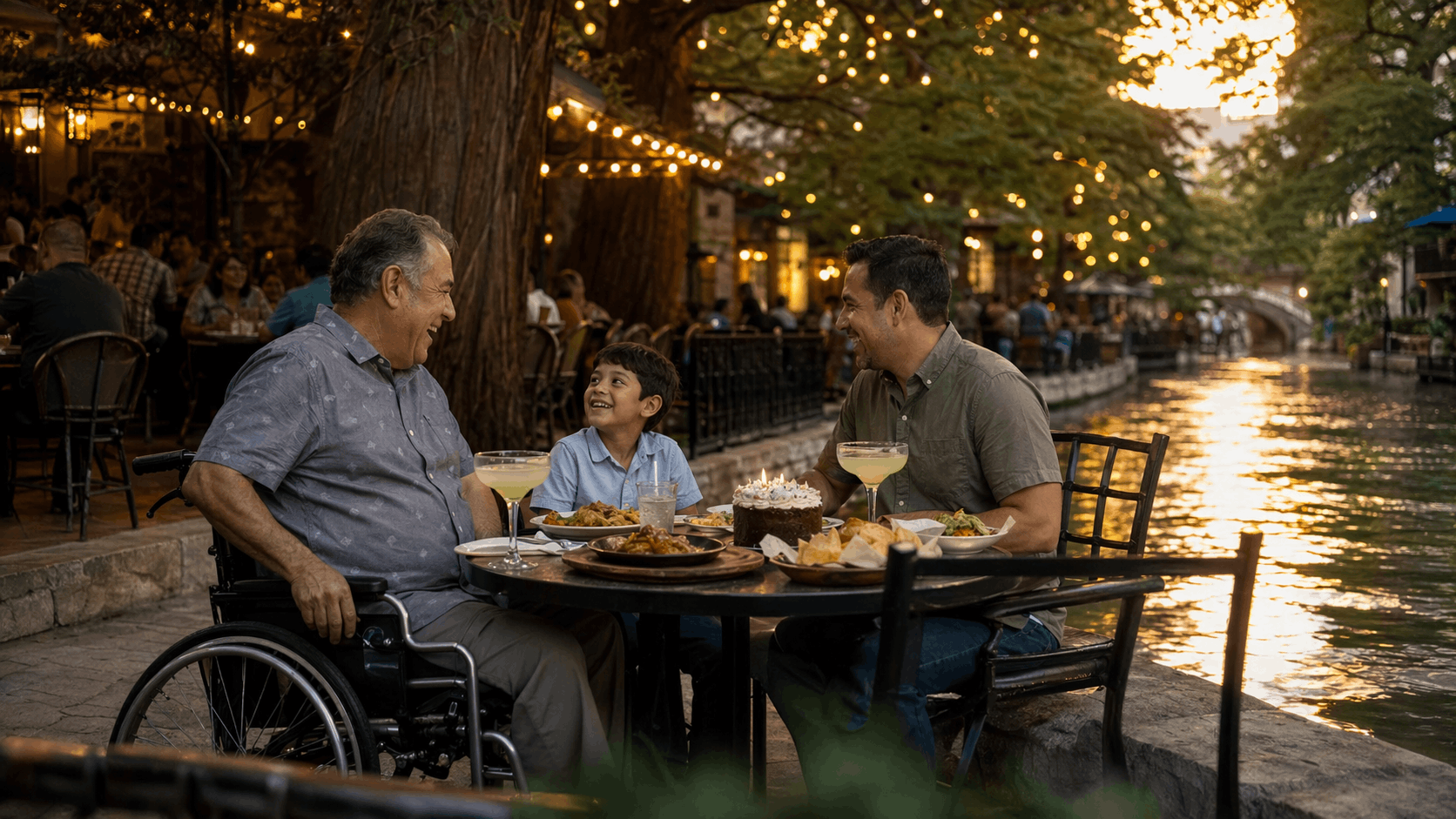
San Antonio runs on tourism, on the medical center, on the military bases, and on a thousand small Tex-Mex restaurants, grocery stores, and neighborhood businesses that serve locals every day. When one of those businesses fails a disabled Texan — a customer hurt on a broken ramp, a grandmother who falls geting out of her car because the accessible parking lot hasn’t been painted in a decade — Texas has its own law for that. Not the federal ADA. Texas Human Resources Code Chapter 121. And most San Antonio lawyers have never filed a case under it.
I have. I’m based in San Antonio, I take Chapter 121 cases for Bexar County residents, and I treat them as what they are — statutory violations with statutory damages, not standard premises-liability slip-and-falls. This page is the local landing for my Texas ADA practice. If you were injured or denied access because a San Antonio business didn’t follow the statute, start here.
“Is somebody going to squeeze next to my car where there’s literally six inches between and I’ve got a 31-inch wheelchair.”
— Lydia Springer, Texas wheelchair user, quoted in the Texas Tribune, 2023
Chapter 121 applies to almost every private business open to the public in San Antonio — hotels, restaurants, retail, office buildings, apartment common areas, gas stations, and medical offices alike — under the broad “public facility” definition in Tex. Hum. Res. Code § 121.002(5). The statute has been Texas law since 1979, eleven years before Congress passed the federal Americans with Disabilities Act.
Texas ADA Cases We Handle in San Antonio
Chapter 121 injury cases in Bexar County tend to cluster in a handful of recurring fact patterns.
- Wheelchair ramp and curb cut falls — ramps too steep, too slippery, missing handrails; the ceramic-tile ramp at a downtown restaurant; the worn-smooth curb cut outside a retail strip on Loop 410.
- Handicap parking lot injuries — cracks and potholes in the accessible space, faded striping, blocked access aisles, slopes that destabilize a wheelchair transfer.
- Inaccessible restroom injuries — grab bars that rip out of the wall, stalls too narrow to transfer, unsafe turning clearances.
- Hotel and short-term rental accessibility injuries — a particular issue in the River Walk and downtown lodging corridor, where older buildings and historic-preservation tensions produce rooms that are marketed as “accessible” but have 28-inch bathroom doors in reality.
- Restaurant accessibility injuries — entrance thresholds, interior aisles, heavy doors, and restrooms in restaurants across SA — especially on I-10, Loop 410, Loop 1604, and the Highway 281 corridor.
- Apartment and condominium common-area injuries — leasing offices, model units, clubhouses, pool decks, and mailrooms. Federal courts have confirmed that even model homes qualify as public facilities under Chapter 121 (Sapp v. MHI Partnership, N.D. Tex. 2002).
- Service-animal refusals — a San Antonio pattern documented in local news as early as 2015 and that still recurs at restaurants and retail. Chapter 121 covers service-animal users explicitly under § 121.003(b).
Common San Antonio Defendants in Texas ADA Cases
I don’t publish a list of names. Most of the defendants in the cases I take are local small and medium businesses, franchise operators, hotel and apartment ownership groups, and retail chains — and most of them had no idea the Texas statute exists until they received a notice letter. That isn’t an excuse, but it’s context.
The recurring defendant categories in Bexar County Chapter 121 cases look like this:
- Hotels, motels, and short-term rentals serving tourists downtown, on the River Walk, and near the Alamo, Sea World, Fort Sam Houston, and the airport
- Tex-Mex restaurants, franchise chains, and neighborhood eateries with access issues at the entrance, in the parking lot, or in the restrooms
- Grocery stores, big-box retailers, and shopping centers along Loop 410, Loop 1604, and the Highway 281 corridor with faded or defective accessible parking
- Medical office buildings in the South Texas Medical Center and on Fredericksburg Road — ironic defendants in disability-access cases, but common
- Apartment complexes and condominium associations, especially those built before the mid-1990s with retrofitted (and sometimes non-compliant) common-area access
- Gas stations, convenience stores, and truck stops along I-10, I-35, and I-37 — the corridors that connect San Antonio to Corpus Christi, Austin, Houston, and the RGV
- Standalone retail stores, service businesses (nail salons, barber shops, dry cleaners), and neighborhood bars
Chapter 121 does not apply to Texas state and local government entities. Texas sovereign immunity was not waived by § 121.004 (Schraer v. Texas Health and Human Services Commission, Tex. App.—Corpus Christi 2014). That means claims against the City of San Antonio, Bexar County, the Texas Department of Public Safety, Texas DMV, VIA Metropolitan Transit, and similar government defendants fall outside Chapter 121. When a governmental entity is the defendant, a different statute fits — the Texas Tort Claims Act, the federal ADA Title II, or both. Call and we’ll figure out which.
How a Texas ADA Case Works in Bexar County
A Chapter 121 claim in Bexar County requires three elements: qualifying disability under § 121.002(4) or Chapter 469; public-facility status under § 121.002(5); and a statutory violation — denial of access, refused accommodation, or failure to meet the Texas Accessibility Standards. Proving those three elements establishes liability. From there, the case runs through these procedural stages.
Intake. I screen the call personally. I want to know what happened, when, where, who the defendant is, what the injury is, whether you qualify as a person with a disability under Tex. Hum. Res. Code § 121.002(4) (or Chapter 469’s broader definition, which covers aging), and whether you have photos, medical records, and documentation of the disability. If the facts fit, we move forward. If they don’t, I say so.
Documentation. Photos of the defect. Site visit, often by me personally. Measurements of ramp slopes, parking-space widths, restroom clearances, or whatever the specific issue is. Medical records confirming disability and injury. A chronology of the incident. For many cases, I also retain a TDLR-licensed Registered Accessibility Specialist to document the Texas Accessibility Standards violations formally.
60-day notice to cure. Where the claim is based on failure to comply with design, construction, or technical standards, Tex. Hum. Res. Code § 121.0041 requires 60 days written notice before suit. The notice describes each alleged violation in reasonable detail, including the date, place, and manner the client discovered it. The notice cannot demand a dollar amount or a settlement. The business gets 60 days to fix the violation; if they do, the case may be dismissed. If they don’t, we file.
Filing. Chapter 121 claims typically file in Bexar County District Court or the appropriate Bexar County Court at Law. The Bexar County Courthouse at 100 Dolorosa Street in downtown San Antonio houses the civil district courts. Filing under Chapter 121 alone keeps the case in state court. Adding a federal ADA claim generally removes it to the U.S. District Court for the Western District of Texas, San Antonio Division. Most San Antonio disability-access cases can be brought under either the federal ADA or Chapter 121, but the Texas statute often produces better outcomes for the plaintiff because of its broader disability definition and state-court venue.
Discovery and mediation. Standard civil discovery — written interrogatories, requests for production, depositions of the defendant’s facility manager or owner, often site inspections. Bexar County civil courts refer most cases to mediation before trial. Many Chapter 121 cases resolve at mediation.
Trial or resolution. If the case doesn’t settle, we try it. Chapter 121 cases are strict-liability in posture — the plaintiff must prove disability status, public-facility status, and the violation; the defendant then bears the burden on whether any modification would fundamentally alter the facility. The $300 statutory minimum damages floor attaches to each proven violation; actual damages ride on top. Federal courts applying Chapter 121 have awarded $250 per violation across multiple violations from a single incident, producing $750 in statutory damages in one Southern District of Texas case (Diaz v. Doneraki Restaurants, S.D. Tex. 2014).
Why San Antonio’s Tourism Economy Drives Texas ADA Claims
San Antonio is consistently among the most-visited cities in the United States — the Alamo, the River Walk, Sea World, Six Flags Fiesta Texas, the Pearl, the Tobin Center, the rodeo, Spurs games, conventions at the Henry B. González Convention Center. The city’s economy runs on hospitality. That creates a concentration of public-facing businesses — hotels, restaurants, retail — that Chapter 121 directly covers.
Tourism also produces two things relevant to disability-access litigation: a lot of older buildings retrofitted for accessibility, often incompletely; and a lot of disabled visitors and disabled San Antonians using those buildings every day. Some of the most common case patterns come from this intersection — a historic downtown restaurant with a non-compliant threshold, a hotel with an “accessible” room that has a 28-inch bathroom door, a River Walk bar reached only by a ramp that’s too steep under the Texas Accessibility Standards, a convention hotel with a bathroom stall too narrow for transfer.
San Antonio also has a large veteran and military-retiree population, between Joint Base San Antonio (Randolph, Lackland, Fort Sam Houston) and the tens of thousands of retirees in the metro. Many of those veterans have PTSD — listed explicitly in Tex. Hum. Res. Code § 121.002(4)(G) — and many use service animals, mobility aids, or both. When a San Antonio business refuses to accommodate a service dog or fails to give meaningful access to a disabled veteran, the Texas statute is the direct path.
And San Antonio is a majority-Hispanic city with a large multigenerational household population. A Chapter 121 case often isn’t just about the person who was hurt — it’s about the adult daughter helping her mother to the restaurant, the grandson driving his grandfather to the medical appointment, the family that planned to eat out together and got stopped at the door. Chapter 469’s aging category covers the grandparent; the statute protects the whole party’s dignity.
Talk to a San Antonio Texas ADA Lawyer
If a San Antonio business hurt you, or turned you away, because it didn’t follow the accessibility standards Texas law requires, call. I personally screen these San Antonio accessibility cases. I’ll tell you whether Chapter 121 fits what happened, whether the federal ADA is the stronger angle, whether the facts support a real claim, or whether this isn’t the kind of case worth filing.
I don’t run technical-violation sweep cases. I take cases where a disabled San Antonian was actually hurt or denied access in a way that mattered. No pressure. No billboard talk. The call goes to my office on Chulie Drive, not a call center.
Clanton Law Office
926 Chulie Dr., San Antonio, Texas 78216
Call 210-226-0800
[email protected]
Works Cited
- Tex. Hum. Res. Code § 121.002(4). Definition of “person with a disability.”
- Tex. Hum. Res. Code § 121.002(5). Definition of “public facility.”
- Tex. Hum. Res. Code § 121.003. Discrimination prohibited.
- Tex. Hum. Res. Code § 121.004(b). Conclusive presumption of statutory damages.
- Tex. Hum. Res. Code § 121.0041. Procedures for Certain Actions; Opportunity to Cure.
- Tex. Gov’t Code § 469.001(b). Scope of Chapter — including aging.
- Sapp v. MHI Partnership, Ltd., 199 F. Supp. 2d 578 (N.D. Tex. 2002).
- Schraer v. Texas Health and Human Services Commission, No. 13-12-00702-CV (Tex. App.—Corpus Christi 2014).
- Diaz v. Doneraki Restaurants, Inc., Civil Action No. H-12-2238 (S.D. Tex. 2014).
This page is general information about Texas law, not legal advice. Every case is different. Results depend on the facts of the case and the applicable law. Past results do not guarantee future results.