

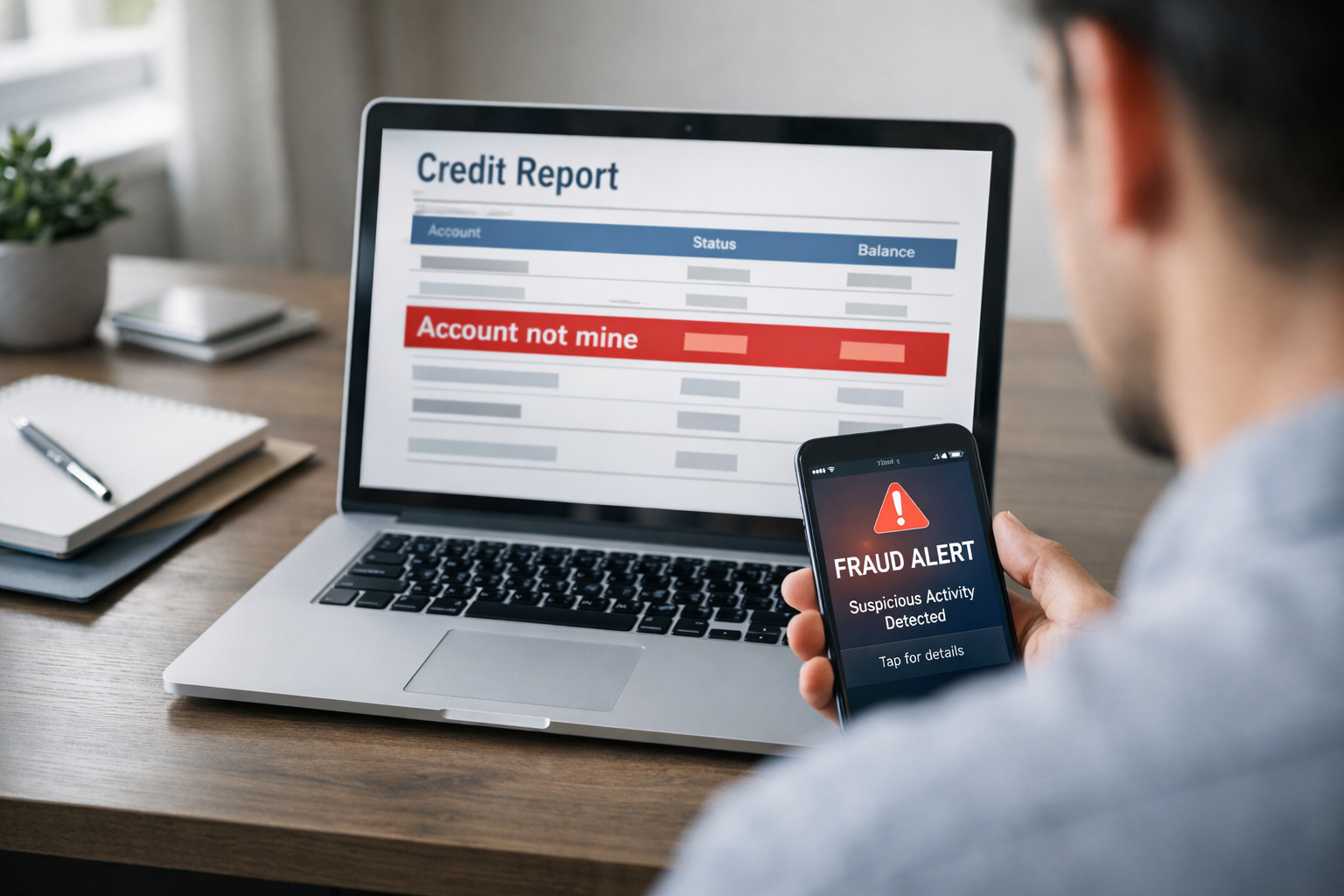
You just discovered a credit card account you never opened. Maybe you were denied credit and found out why. Maybe a collection agency called about a debt you’ve never heard of. Maybe your credit score dropped for no reason you can explain.
Take a breath. You’re not alone, and this is fixable. You have rights under federal law. The Fair Credit Reporting Act (FCRA) gives you powerful tools to fight back.
Do These 5 Things Now
- Contact the creditor’s fraud department — close the account, flag it as fraud, request written confirmation.
- Place a fraud alert or credit freeze — contact one bureau for alerts (they notify the others) or all three for freezes.
- File an FTC Identity Theft Report — go to IdentityTheft.gov; this is your legal affidavit.
- Dispute with all three credit bureaus by certified mail — include your FTC report, police report, and ID; track the 30-day deadline.
- Escalate if disputes fail or fraud reappears — you may have legal options under the FCRA, including the right to sue.
Sources: FTC IdentityTheft.gov; FCRA §605B (15 U.S.C. §1681c-2); FCRA §609(e) (15 U.S.C. §1681g(e))
Fast Facts
- In 2024, the FTC received 1.1 million identity theft reports. (FTC Consumer Sentinel Network Data Book 2024)
- For identity theft reports per capita, the FTC’s top states in 2024 included Texas (alongside Florida, Georgia, Nevada, and Delaware). (FTC Consumer Sentinel Network Data Book 2024)
- In 2024, the CFPB received approximately 3.2 million consumer complaints. (CFPB Consumer Response Annual Report 2024)
- The CFPB reports credit reporting complaints increased 182% in 2024. (CFPB Consumer Response Annual Report 2024)
- Under FCRA §605B (15 U.S.C. §1681c-2), a credit bureau must block identity-theft information within 4 business days after receiving required documentation. (15 U.S.C. §1681c-2)
- In the ITRC’s 2025 survey, 48% of identity theft victims reported their case was “not yet resolved” (i.e., still ongoing). (ITRC 2025 Consumer Impact Report)
Key Facts (With Sources)
| Fact | Source |
|---|---|
| FTC received 1.1 million identity theft reports in 2024 | FTC Consumer Sentinel Network Data Book 2024 |
| FTC top states (per capita) for identity theft reports in 2024 included Texas | FTC Consumer Sentinel Network Data Book 2024 |
| CFPB received ~3.2 million consumer complaints in 2024 | CFPB Consumer Response Annual Report 2024 |
| CFPB: credit reporting complaints increased 182% in 2024 | CFPB Consumer Response Annual Report 2024 |
| ITRC 2025: 48% of victims reported their case “not yet resolved” (ongoing) | ITRC 2025 Consumer Impact Report |
Key Terms
New account fraud: A thief opens a new credit card, loan, or utility account using your identity.
Account takeover: A thief gains access to an existing account you already had.
Mixed file: Your credit file contains someone else’s data due to name, SSN, or address matching errors at the credit bureau.
What’s in This Guide
- Need Help Now? When to Call a Lawyer Immediately
- Which Problem Do You Have?
- First, Verify the Account Is Fraudulent
- What to Do Immediately (First 24–48 Hours)
- Create Your Official Paper Trail
- How to Dispute Fraudulent Accounts
- When Credit Bureaus Refuse to Remove Accounts
- Fraud Alerts vs. Credit Freezes
- Your Legal Rights Under the FCRA
- Frequently Asked Questions
Required Documents
Before you begin, gather these items:
| Document | Why You Need It |
|---|---|
| Government-issued ID (driver’s license or passport) | Proves your identity to bureaus and creditors |
| Proof of current address (utility bill, bank statement) | Confirms where you live |
| Credit reports from all three bureaus | Identifies all fraudulent accounts (free at AnnualCreditReport.com) |
| Statements or notices about the fraudulent account | Documents what you received |
| FTC Identity Theft Report | Legal affidavit; create at IdentityTheft.gov |
| Police report (recommended) | Formal crime record; strengthens disputes |
Need Help Now? When to Call a Lawyer Immediately
If any of the following are true, consider calling an identity theft attorney before going further:
- You’ve been sued for a debt that isn’t yours
- You were denied housing, employment, or credit because of fraudulent accounts
- Debt collectors keep calling about accounts that aren’t yours
- You already disputed and the credit bureau refused to remove the fraudulent account
- The same fraudulent information keeps reappearing after deletion (reinsertion)
Contact Us for a Free Consultation
Not ready to call? Download our free Identity Theft Dispute Packet (checklist + letter templates) or schedule a free 10-minute triage call.
Which Problem Do You Have?
- New account opened in your name (credit card, loan, utility) → This guide covers your situation (Identity Theft / FCRA)
- Unauthorized bank transfer, debit card charge, Zelle, or ACH → See our guide on EFTA Rights
- Your credit report shows someone else’s accounts (mixed file) → See our guide on Mixed Credit Files
First, Verify the Account Is Fraudulent—But Know You May Have Rights Either Way
Summary: Not every unknown account is identity theft. It could be a mixed file, an authorized user situation, or an old account. Either way, the FCRA protects you from inaccurate credit reporting.
Before taking action, take a moment to verify what you’re dealing with. New account fraud occurs when someone uses your personal information—Social Security number, name, date of birth—to open accounts without your authorization.
But not every unknown account on your credit report is identity theft. Sometimes accounts appear that belong to someone else entirely—a mixed file error where the credit bureau confused you with another person. Sometimes you’re listed as an authorized user on a family member’s card you forgot about. Sometimes it’s an old account you don’t remember.
Here’s the important part: even if the account isn’t identity theft, you may still have legal remedies under the FCRA. Mixed files, reinsertion of previously deleted information, and reporting of outdated accounts are all FCRA violations—regardless of whether a criminal is involved. The law protects you from inaccurate credit reporting, period.
Quick Verification Checklist
- ☐ Check if you’re listed as an authorized user on a family member’s account
- ☐ Review whether it might be an old account you forgot about
- ☐ Confirm the account details (address, employer, SSN) don’t match yours
- ☐ Determine if the account belongs to someone else entirely (mixed file)
If the account is fraudulent or simply doesn’t belong to you, proceed with the steps below.
What to Do Immediately After Discovering Fraudulent Accounts
Summary: In the first 24–48 hours, contact the creditor’s fraud department, place a fraud alert, and send an initial letter to the credit bureaus by certified mail.
Step 1: Contact the Creditor
Call the fraud department—not general customer service—of the company that opened the unauthorized account. Request that they close the account immediately and flag it as fraud. Ask for written confirmation of their fraud determination.
Federal law (FCRA §609(e), 15 U.S.C. §1681g(e)) gives identity theft victims the right to request application and transaction records from the business—once you provide proof of identity and an identity theft report. Request these documents; they can be valuable evidence if you need to escalate.
Step 2: Place a Fraud Alert
Contact one of the three major credit bureaus to place a fraud alert on your file. By law, whichever bureau you contact must notify the other two. A fraud alert requires creditors to take extra steps to verify your identity before opening new accounts.
Reject aptional credit-monitoring/identity products offered by credit bureaus as they include arbitration and class-action waiver terms. If you’re asked to enroll in a paid monitoring product while placing an alert/freeze, read the terms carefully (and opt out if permitted). You can place fraud alerts and credit freezes without buying monitoring.
Credit Bureau Fraud Alert Contact Info
Fraud alert: Contact ONE bureau and it must notify the other two. (FTC)
| Bureau | Phone | Fraud Alert URL (verify before using) |
|---|---|---|
| Equifax | 800-525-6285 | equifax.com/personal/credit-report-services/credit-fraud-alerts/ |
| Experian | 888-397-3742 | experian.com/help/fraud-alert/ |
| TransUnion | 800-680-7289 | transunion.com/fraud-alerts |
Step 3: Send an Initial Letter to the Credit Bureaus—Don’t Wait
You don’t need to wait for your FTC report or police report to notify the credit bureaus in writing. Send a letter by certified mail stating that you believe you are a victim of identity theft and that specific accounts on your report are fraudulent. This starts the clock on your dispute and creates a paper trail from day one.
Send this letter to all three credit bureaus. Even a brief letter identifying the fraudulent accounts puts them on notice while you gather your official documentation.
Create Your Official Paper Trail: FTC Report and Police Report
Summary: File an FTC Identity Theft Report at IdentityTheft.gov (this is your legal affidavit) and a police report. With these documents, you can request a §605B block—bureaus must block fraudulent information within 4 business days.
Step 4: File an FTC Identity Theft Report
Go to IdentityTheft.gov and complete the FTC Identity Theft Report. This creates a legal document—an official affidavit—that you can use to dispute fraudulent accounts and block debt collectors from collecting on fraudulent debt under FCRA §605B (15 U.S.C. §1681c-2).
The FTC report also generates a personalized recovery plan based on your specific situation. Print your completed report and keep it with your records.
⚡ Fast Track: The §605B Block
Under FCRA §605B, if you submit a valid identity theft report and proof of identity, credit bureaus must block the fraudulent information from your report within 4 business days. This is one of the most powerful tools available to identity theft victims under the FCRA.
Step 5: File a Police Report
File a report with your local police department. Bring your FTC Identity Theft Report with you. A police report establishes a formal record of the crime, which credit bureaus and creditors often require before removing fraudulent accounts.
Request a copy of the police report for your records. You’ll include this with your formal disputes.
How to Dispute Fraudulent Accounts on Your Credit Report
Summary: Send written disputes by certified mail to all three credit bureaus. Include your FTC report, police report, and proof of identity. Bureaus must investigate within 30 days and delete information they cannot verify.
Now it’s time to formally dispute the fraudulent accounts with each credit bureau. This is where the FCRA gives you real power.
Under the FCRA, credit bureaus must investigate your dispute within 30 days—or 45 days if you submit additional information during the investigation. If the bureau cannot verify the account, they must delete it from your credit report.
Why Certified Mail Is the Most Defensible Way to Dispute
Certified mail is the most defensible method if litigation becomes necessary, because it preserves what you sent and when it was received.
Online disputes don’t give you a record of exactly what you submitted. Phone disputes leave no paper trail. If you ever need to prove what you told the credit bureau—and when—certified mail with return receipt requested is the best way to create that evidence.
Phone disputes can serve an important part of a set of disputes, but not before written disputes.
This matters because if the credit bureau fails to properly investigate, you may need to prove exactly what information they received and when they received it. That proof can make the difference between winning and losing if your case goes to court.
What to Send (Dispute Packet Checklist)
| Document | Notes |
|---|---|
| Dispute letter | Identify each fraudulent account by name, account number, and reason |
| FTC Identity Theft Report | Your legal affidavit |
| Police report | Formal crime record |
| Government-issued ID (copy) | Driver’s license or passport |
| Proof of address (copy) | Utility bill, bank statement |
Credit Bureau Dispute Mailing Addresses
Verify before mailing; addresses can change.
| Bureau | Mailing Address |
|---|---|
| Equifax | P.O. Box 740256, Atlanta, GA 30374-0256 |
| Experian | P.O. Box 4500, Allen, TX 75013 |
| TransUnion | P.O. Box 2000, Chester, PA 19016 |
Step 6: Dispute Steps
- Obtain your free credit reports from all three bureaus (AnnualCreditReport.com)
- Identify each fraudulent account
- Write a dispute letter for each bureau listing each fraudulent account
- Include copies of supporting documents: FTC report, police report, proof of identity
- Send via certified mail with return receipt requested
- Keep copies of everything you send
- Track the 30-day investigation deadline from the date of receipt
When Credit Bureaus Refuse to Remove Fraudulent Accounts
Summary: If the bureau claims the account was “verified,” that doesn’t mean they conducted a reasonable investigation. You can sue under the FCRA, and attorney’s fees are recoverable—meaning legal help often costs you nothing out of pocket.
This is frustrating, but it’s not the end of the road. “Verified” doesn’t mean the credit bureau conducted a reasonable investigation. In fact, the CFPB received approximately 3.2 million consumer complaints in 2024—with credit reporting complaints increasing 182% from prior years—and “incorrect information on report” was the most common issue. (Source: CFPB Consumer Response Annual Report 2024)
What Bureaus Often Do When They “Verify”
Credit bureaus typically use an automated system called e-OSCAR to forward your dispute to the creditor. The creditor checks their records and responds “verified” or “not verified.” The bureau accepts this at face value—often without reviewing your supporting documents or conducting any independent investigation.
Under the FCRA, credit bureaus are required to conduct a reasonable investigation of your dispute. Simply forwarding your dispute to the creditor and accepting whatever they say back isn’t enough.
Your Options When Disputes Fail
You can sue credit bureaus that fail to conduct a reasonable investigation of your identity theft dispute. The FCRA provides real consequences for violations.
For willful FCRA violations (15 U.S.C. §1681n), consumers may recover:
- Statutory damages of $100 to $1,000 per violation
- Actual damages for any financial harm you suffered
- Punitive damages
- Attorney’s fees and court costs
This last point is important: because the FCRA requires defendants to pay the plaintiff’s attorney’s fees in successful cases, qualified legal representation often costs victims nothing out of pocket.
You also have the right to add a 100-word statement to your credit report explaining the dispute. While this doesn’t remove the fraudulent account, it ensures that anyone who pulls your report sees your side of the story.
Fraud Alerts vs. Credit Freezes: Which Protection Do You Need?
Summary: Fraud alerts require creditors to verify your identity (1 year standard, 7 years extended). Credit freezes block all access until you lift them. Both are free under federal law.
Once you’ve addressed the immediate problem, you need to protect yourself from future fraud. You have two main tools: fraud alerts and credit freezes.
Fraud Alerts
A standard fraud alert lasts one year and requires creditors to verify your identity before opening new accounts. If you’re a confirmed identity theft victim with an FTC report, you can place an extended fraud alert that lasts seven years.
You only need to contact one credit bureau to place a fraud alert—they’re required to notify the other two.
Credit Freezes
A credit freeze (also called a security freeze) blocks all access to your credit report until you lift it. This prevents anyone—including you—from opening new credit accounts while the freeze is in place.
Credit freezes have been free under federal law since September 21, 2018, when the Economic Growth, Regulatory Relief, and Consumer Protection Act took effect. You can freeze and unfreeze your credit as many times as you need at no cost.
Unlike fraud alerts, you must contact each credit bureau separately to place a freeze.
Comparison: Fraud Alert vs. Credit Freeze
| Protection | Duration | Effect | Best For |
|---|---|---|---|
| Fraud Alert | 1 year (7 years extended) | Creditors must verify identity | Active credit users |
| Credit Freeze | Until you lift it | Blocks all credit access | Maximum protection |
Federal Law Protects Identity Theft Victims
Summary: The FCRA gives you specific, enforceable rights: 30-day investigation requirement, §605B block (4 business days), right to business records (§609(e)), right to sue, and attorney’s fee recovery.
The Fair Credit Reporting Act (FCRA) is a federal law enacted in 1970 that regulates how credit bureaus collect, share, and correct consumer credit information. It gives you specific, enforceable rights.
Your Key Rights Under the FCRA
- 30-Day Investigation Requirement: Credit bureaus must investigate your dispute within 30 days and delete information they cannot verify.
- Right to Block Fraudulent Accounts (§605B): Identity theft victims can block fraudulent information within 4 business days after submitting a valid identity theft report and proof of identity.
- Right to Business Records (§609(e)): You can request application and transaction records from businesses where accounts were fraudulently opened.
- Right to Sue: You can sue credit bureaus and furnishers that violate the FCRA.
- Fee-Shifting: For willful violations, defendants must pay your attorney’s fees—meaning qualified legal representation often costs victims nothing out of pocket.
These aren’t just theoretical rights. Courts enforce them every day, and credit bureaus pay real damages when they fail to follow the law.
You Have Rights. You’re Not Alone.
Discovering that someone opened accounts in your name is overwhelming. But remember: this is fixable. Federal law is on your side. You have specific rights that credit bureaus and creditors must respect.
Take it step by step. Document everything. Send your disputes by certified mail. And if the system fails you, know that you have legal options.
If you’re dealing with identity theft in Texas and the credit bureaus aren’t cooperating, we can help. We litigate FCRA cases in federal court and focus on inaccurate credit reporting and identity theft disputes. This is what we do every day—fight for people just like you to get fraudulent accounts removed and hold credit bureaus accountable when they don’t follow the law.
Contact Us for a Free Consultation
Frequently Asked Questions
What should I do first if someone opened a credit card in my name?
Contact the creditor’s fraud department immediately to close the account and flag it as fraud. Then place a fraud alert with one credit bureau (they’ll notify the other two) and send a letter by certified mail to all three bureaus stating you believe you are a victim of identity theft. File an FTC Identity Theft Report at IdentityTheft.gov and consider filing a police report.
How long do credit bureaus have to investigate identity theft disputes?
Under the FCRA, credit bureaus must investigate your dispute within 30 days of receiving it (or 45 days if you submit additional information during the investigation). If they cannot verify the account, they must delete it. For identity theft blocks under §605B, bureaus must block the information within 4 business days.
Can I sue for identity theft?
Yes. Under the FCRA (15 U.S.C. §1681n), you can sue credit bureaus that fail to conduct a reasonable investigation of your dispute. For willful violations, you may recover statutory damages of $100 to $1,000 per violation, actual damages, punitive damages, and attorney’s fees. Because defendants must pay attorney’s fees in successful cases, legal representation often costs victims nothing out of pocket.
Is a credit freeze free?
Yes. Credit freezes have been free under federal law since September 21, 2018, under the Economic Growth, Regulatory Relief, and Consumer Protection Act. You can freeze and unfreeze your credit as many times as you need at no cost.
Should I dispute online or by mail?
We recommend disputing by certified mail with return receipt requested. This is the most defensible method if litigation becomes necessary, because it preserves what you sent and when it was received. Online and phone disputes leave no reliable paper trail of exactly what you submitted.
What’s the difference between new account fraud and account takeover?
New account fraud occurs when a thief opens a new credit card, loan, or utility account using your identity. Account takeover occurs when a thief gains access to an existing account you already had. Both are forms of identity theft, but they may require different remediation steps.
What does it mean when the credit bureau says the account was “verified”?
It usually means the bureau forwarded your dispute to the creditor through an automated system, and the creditor responded that the information was accurate. It does not necessarily mean the bureau conducted a reasonable investigation. If you have evidence of fraud and the bureau still refuses to remove the account, you may have legal options under the FCRA.